– Driven By Digital Technology and Base On The Trust
1. Preface
Modern people’s life has been greatly transformed by the digitization in this time and era. Whatever real and virtual worlds, it has been driving a new business model to contribute to economic improvement and social change, where people can put their innovation into it (Kagermann, 2015). Thus, as a non-business student before, I chose BEMM129: Digital Business Model as my optional module this term because I want to understand how it disrupts or improves individual, organizational, social so that I can organically combine my major: Innovation Business Strategy with it. This reflective article will follow Gibbs’ cycle (Gibbs, 1988) and base on my feelings and thoughts before and after learning this module, to objectively analyze what I have learned from it and what I need to develop further. Besides, it also will help me critically reflect myself to achieve my personal growth in the future.
2. Description
After my active learning process, I found it is helpful and different from other lectures: most of our work took place online. Our module educator is not only Lisa but also the whole cyberspace. This module guided me on how to learn online (Harris & Truelove). Thus, I used MOOC and resources shared on ELE to obtain new knowledge. Besides, it provided me with more opportunities to share ideas and comment on other students’ blogpost.
3. Feelings/Thoughts
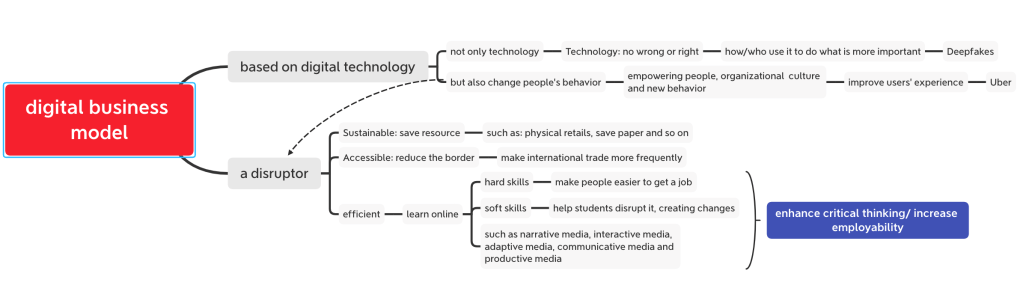
At first, I was a little confused because I have never experienced learning online before. However, after this module, I realized it is not only “the use of new technologies in business models and infrastructure has been driven in part by the Internet and globalization.” (Zhuhadar et al., 2017) but also has the power to cause individual, organizational and social change. Take an example of Uber, it used a digital platform to drive new business: sharing economy. It is “a ridesharing experience that allows users to request a car through a smartphone app, was developed in the midst of this new consumer culture in which access to commodities is more valuable than individual ownership.” (Posen, 2015). Its success has improved users’ experience of taking a taxi and transformed their commuting habits so that it finally led to social change.
4. Evaluation
I still remembered the week 5 video resource (Botsman, 2016). It helped me understand the essence of the digital business model: trust. We trust the technology, so we use it. We trust the sellers whom we have never seen before, so we buy items online. Therefore, I have learned a lot of new knowledge from this module. However, one thing I need to improve further: ask questions positively in the class.
5. Analysis
The digital business model is based on digital technology, being a technology, itself has no wrong or right. It depends on people how to use it and to do what. Take an example of Deepfakes. It is illegal in many countries (Gallagher, 2019). But this technology was used in ‘Fast & Furious 7’ when the actor Paul Walker dead. It helped the film company reduce the cost (Weisman, 2014). Thus, the digital business model is useful in modern society.
6. Conclusion & Action Plan
In summary, I learned a lot of new knowledge from this module and it taught me how to study online. I also noticed that why the digital business model has dominated marketing for a long time. Because of its advantages: 1. Sustainable 2. Accessible 3. Affordable. With the learning process, I have gained personal growth. I will continue to use the Internet to study in the future.
(Word Count: 431)
7. Reference
- Kagermann, H., 2015. Change through digitization—Value creation in the age of Industry 4.0. In Management of permanent change (pp. 23-45). Springer Gabler, Wiesbaden.
- Gibbs, G., 1988. Learning by doing: A guide to teaching and learning methods.
- Harris, L. and Truelove, A., n.d. Learning To Learn Online. The University of Exeter.
- Zhuhadar, L., Thrasher, E., Marklin, S. and de Pablos, P.O., 2017. The next wave of innovation—Review of smart cities intelligent operation systems. Computers in Human Behavior, 66, pp.273-281.
- Posen, H.A., 2015. Ridesharing in the sharing economy: Should regulators impose Uber regulations on Uber. Iowa L. Rev., 101, p.405.
- Gallagher, S., 2019. What Are Deepfakes, Are They Illegal And Can They Be Stopped?. [online] Huffingtonpost.co.uk. Available at: <https://www.huffingtonpost.co.uk/entry/what-is-deep-fake-pornography-and-is-it-illegal-in-the-uk_uk_5bf4197ce4b0376c9e68f8c5> [Accessed 30 March 2020].
- Weisman, A., 2014. ‘Fast & Furious 7’ Is Using New Technology To Replace Paul Walker With His Brothers. [online] Business Insider. Available at: <https://www.businessinsider.com/how-fast-and-furious-7-replaced-paul-walker-with-brothers-2014-4?r=US&IR=T> [Accessed 31 March 2020].
8. Appendix
Appendix 1: my personal new cognition of the digital business model
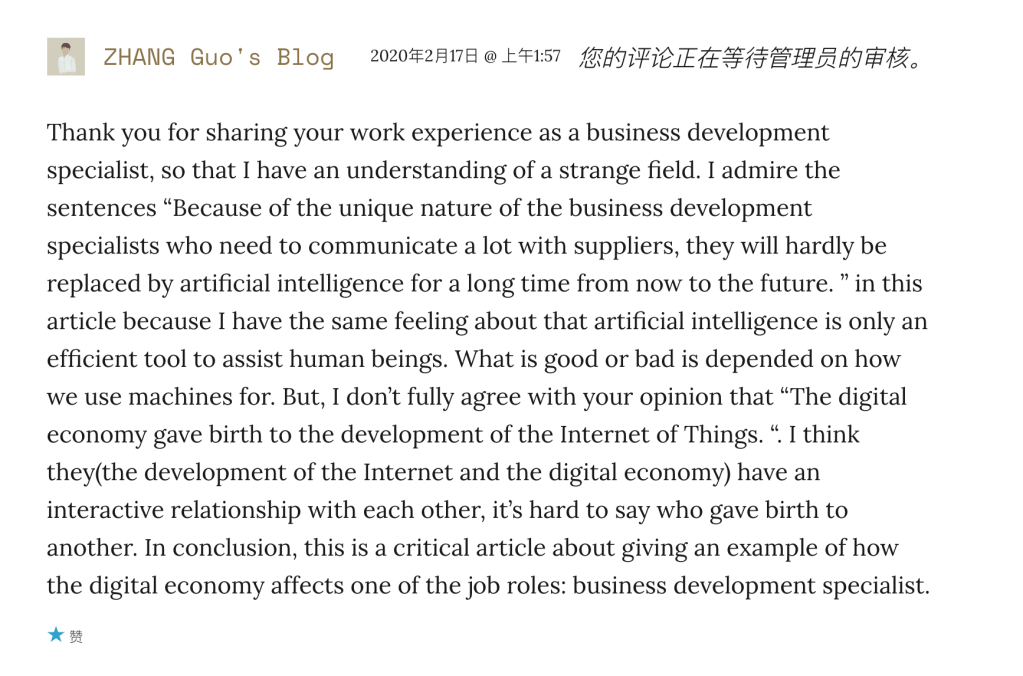
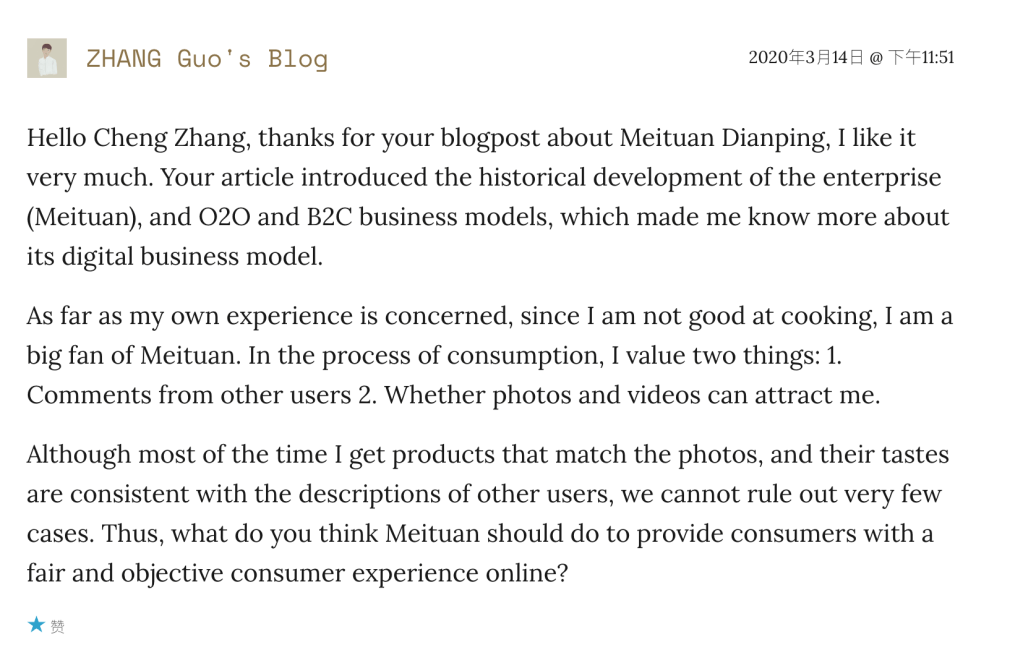
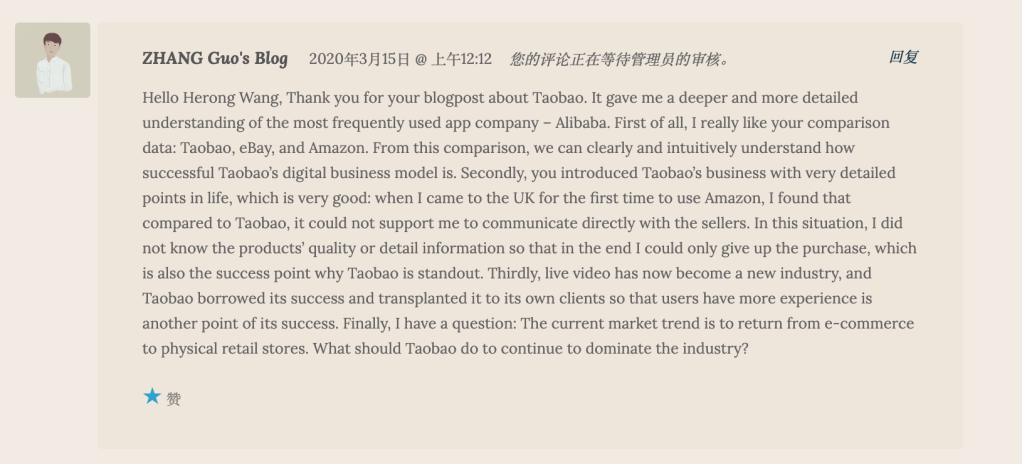
Appendix 2: My comments on other students’ blogpost
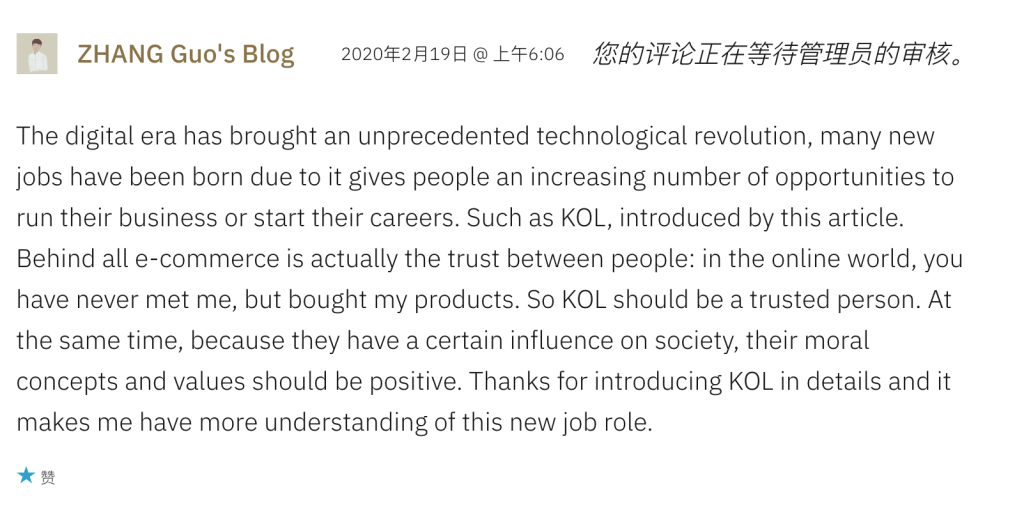
2.URL:https://jianing.art.blog/2020/02/14/how-kol-was-born/
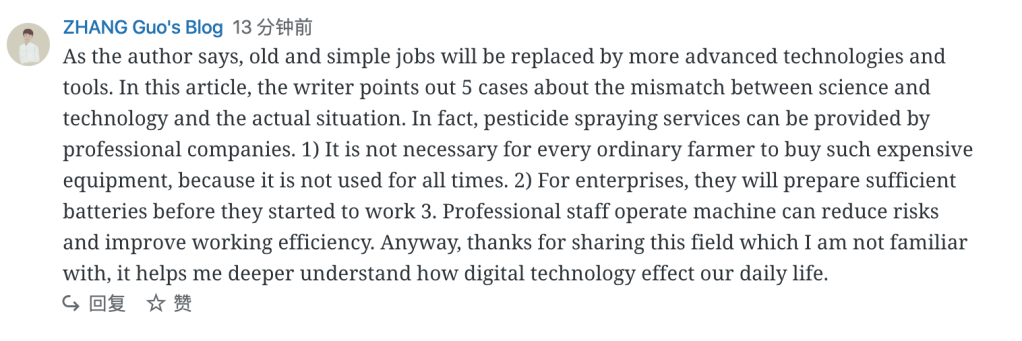
Appendix 3: MOOC Model Study
Appendix 4: short video
https://app.biteable.com/video/11926404/preview
 ZHANG Guo's Blog